

 English
 中文简体
中文简体 русский
Product Consultation
Your email address will not be published. Required fields are marked *

Content
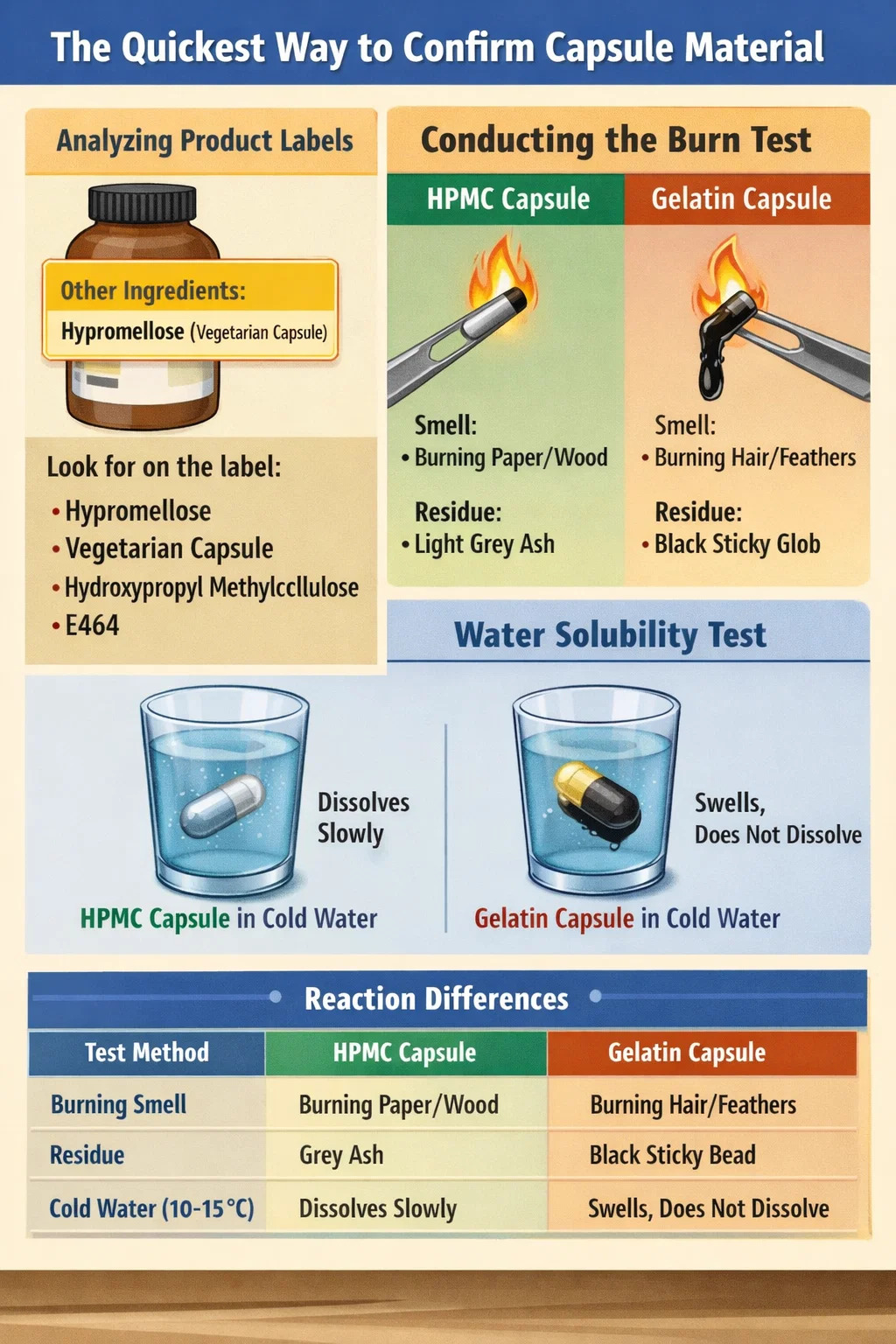
To immediately identify an HPMC capsule (hydroxypropyl methylcellulose), look for the keyword "Hypromellose" or "Vegetarian" on the product label. If you are examining a loose capsule without packaging, the most reliable field method is the "Burn Test." When an HPMC capsule is exposed to a flame, it smells like burning paper or wood and leaves a light, greyish ash. In contrast, a gelatin capsule will smell distinctly like burning hair or feathers due to its animal protein content and will melt into a black, sticky globule.
Visual inspection alone is rarely sufficient because modern manufacturing techniques have made HPMC capsules nearly indistinguishable from gelatin in terms of gloss and clarity. Therefore, checking the chemical behavior—specifically how it burns and how it dissolves—remains the only definitive way to identify the material without laboratory equipment.
Regulatory bodies require ingredients to be listed on packaging, but the terminology can vary depending on the region and the brand. HPMC is the industrial standard for vegetarian capsules, but it appears under several names. If you see any of the following terms in the "Other Ingredients" or "Shell Ingredients" section, you are holding an HPMC capsule:
If the label states "Gelatin," "Bovine Gelatin," or just "Capsule" without specifying the source, it is almost certainly an animal-based product. Manufacturers using HPMC usually highlight this feature as a selling point.
The burn test is a definitive, low-tech method to distinguish plant fibers from animal proteins. You can perform this safely with a lighter and a pair of tweezers.
When you hold a flame to an empty HPMC capsule shell, it will ignite and burn slowly. The flame is typically yellow or blue. The most telling sign is the odor. Since HPMC is derived from pine or cotton cellulose, the smoke will smell like burning wood, paper, or cotton. It does not produce a repulsive odor. The residue left behind will be a lightweight, grey, or white ash that crumbles easily between your fingers.
Gelatin is pure protein (collagen). When exposed to flame, it bubbles and sizzles immediately. The smell is distinct and unpleasant, resembling burnt hair or burnt skin. This happens because of the sulfur-containing amino acids in the protein structure. Unlike the clean ash of HPMC, gelatin leaves behind a swollen, black, sticky, and hard bead that is difficult to crush.
HPMC capsules and gelatin capsules behave differently when placed in water at different temperatures. This behavior is a critical identification method used by laboratory technicians.
The Cold Water Test: HPMC is generally soluble in cold water. If you place an HPMC capsule in cold water, it will eventually dissolve, though the process is slower than in warm water. Gelatin, however, is insoluble in cold water. In cold water, gelatin will absorb water and swell significantly, becoming a rubbery, soft mass, but it will not dissolve into the liquid until the temperature is raised.
The Tolerance to Humidity: If you leave a capsule out in a very dry environment (low humidity), a gelatin capsule will lose its moisture content (which is usually 13-16%) and become brittle. It will shatter if you pinch it. An HPMC capsule has a much lower moisture content (3-8%) and retains its flexibility even in dry conditions. If you pinch a capsule that has been sitting in dry air and it shatters like glass, it is likely gelatin. If it bends or dents without breaking, it is likely HPMC.
| Test Method | HPMC Capsule Reaction | Gelatin Capsule Reaction |
|---|---|---|
| Burning Smell | Burning paper/wood | Burning hair/feathers |
| Residue | Grey ash | Black sticky bead |
| Cold Water (10-15°C) | Dissolves slowly | Swells (does not dissolve) |
For manufacturers or distributors requiring absolute certainty without destroying the sample via burning, elemental analysis is the standard method. This involves checking the chemical composition of the shell.
The key differentiator is Nitrogen. Gelatin is a protein, and proteins are built from amino acids, all of which contain nitrogen. Therefore, a chemical test on gelatin will always reveal a significant presence of nitrogen. HPMC, on the other hand, is a cellulose ether. Its chemical structure consists of Carbon, Hydrogen, and Oxygen. There is absolutely no nitrogen in a pure HPMC capsule. A simple nitrogen detection test in a lab can confirm the material identity with 100% accuracy.
Another subtle way to identify HPMC capsules, particularly during the filling process or when handling large quantities, is by observing static electricity. Gelatin capsules are highly prone to building up static charge. If you pour a bag of empty gelatin capsules into a hopper or a bowl, they will often stick to the sides of the container or repel each other aggressively, "jumping" around.
HPMC capsules generally exhibit lower static charge. They flow more smoothly and do not stick to plastic bags or machine hoppers as stubbornly as gelatin. While this is not a definitive chemical test, it is a common practical observation used by machine operators to guess the material type before running a production line.
Your email address will not be published. Required fields are marked *
If you would like to learn more about our products, please feel free to contact us and we will do our to assist you.
Copyright © Shaoxing Zhongya Capsule Co., Ltd. High Quality Empty Capsule Manufacturers Wholesale Transparent Empty Capsule Factory
All Rights Reserved.

