
 English
 中文简体
中文简体 русский
Product Consultation
Your email address will not be published. Required fields are marked *

Content
Yes — HPMC capsules are generally easy to swallow, and for most people they are at least as comfortable as gelatin capsules, if not more so. Their smooth outer surface, lightweight shell, and the way they interact with saliva and water all contribute to a swallowing experience that most users find unremarkable in the best sense: the capsule goes down without resistance, without an unpleasant taste, and without the feeling of the capsule sticking in the throat. That said, swallowability is influenced by capsule size, individual physiology, swallowing technique, and hydration — and understanding each of these factors helps explain both why HPMC capsules perform well and what to do when swallowing any capsule feels difficult.
HPMC capsules — made from hydroxypropyl methylcellulose, a plant-derived polymer — have several physical characteristics that work in favor of easy swallowing.
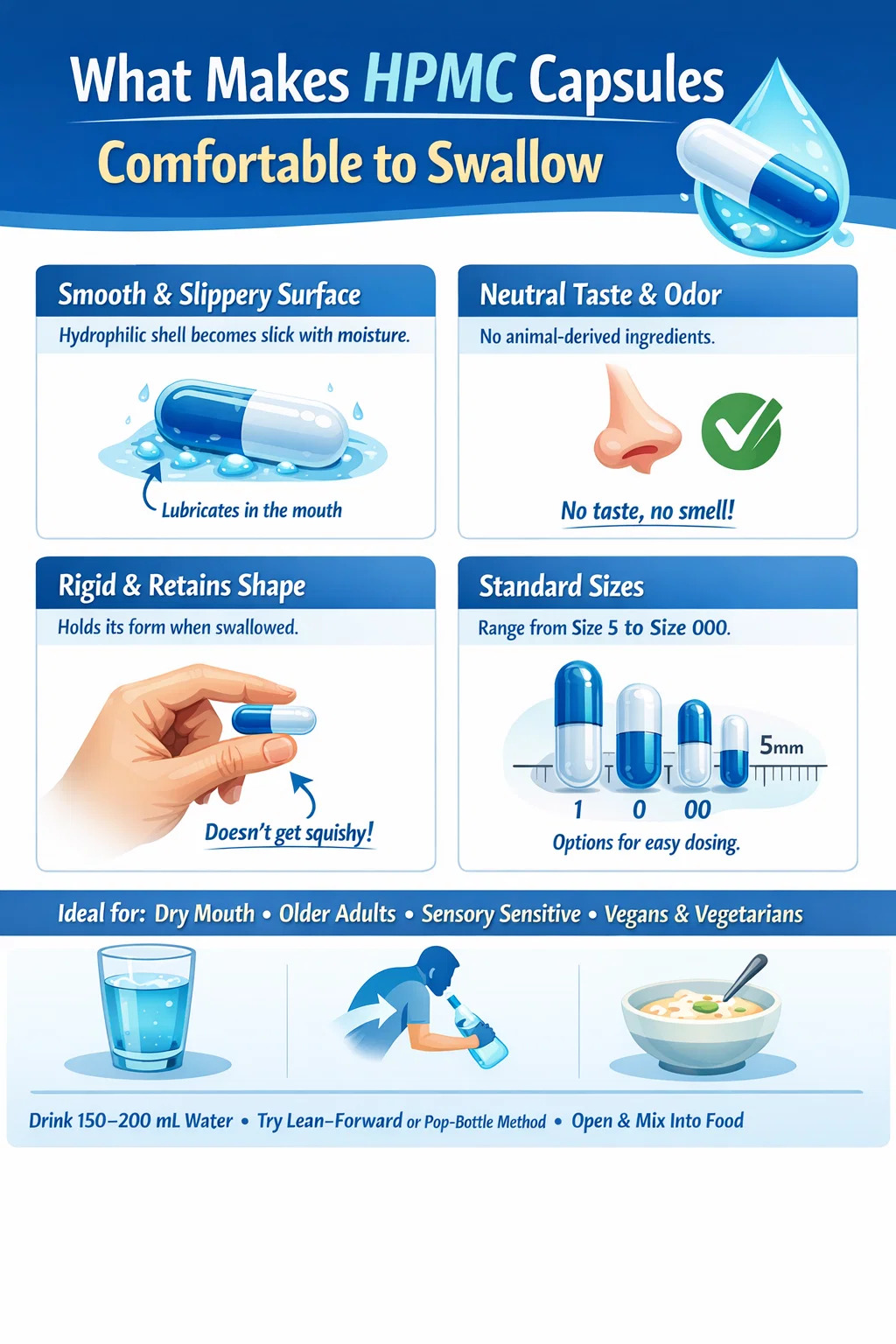
The outer surface of an HPMC capsule is smooth and slightly hydrophilic. When it contacts moisture — either from saliva or water — the surface begins to hydrate and develop a slippery, gel-like layer. This lubricious coating effect is a direct consequence of HPMC's water-swelling behavior and reduces friction between the capsule and the mucosal lining of the throat during swallowing. Many users describe HPMC capsules as feeling "slick" or "slippery" in the mouth once wet, which translates into easier transit through the esophagus.
Gelatin capsules have a similarly smooth surface, but gelatin becomes tacky and slightly sticky when it absorbs moisture rapidly. In practice, this means a gelatin capsule held briefly in a dry mouth before swallowing can adhere slightly to the tongue or palate, whereas HPMC tends not to exhibit this stickiness. This difference is small but noticeable to sensitive users.
HPMC itself is tasteless and odorless. Gelatin, being derived from animal collagen, can have a faint meaty or bone-broth-like odor that some people find off-putting, particularly when capsules are chewed or held in the mouth for an extended time. For users with heightened olfactory sensitivity or those who find animal-derived smells aversive, HPMC capsules present a clearly more neutral sensory experience. This matters practically because any unpleasant taste or smell associated with a capsule increases psychological resistance to swallowing.
HPMC capsules maintain good rigidity at normal moisture levels. A well-formed HPMC capsule does not deform under gentle finger pressure the way a slightly over-moistened gelatin capsule might. This rigidity means the capsule retains its cylindrical shape during swallowing, which is important because a deformed or crumpled capsule is harder to swallow and more likely to cause the sensation of the capsule "catching" in the throat.
The material of the shell matters, but capsule size is the dominant variable in how easy or difficult a capsule is to swallow. HPMC capsules are manufactured in the same standard sizes as gelatin capsules, following the internationally recognized sizing system that ranges from size 5 (smallest) to size 000 (largest).
| Capsule Size | Approximate Length (mm) | Typical Fill Volume (mL) | Common Use |
|---|---|---|---|
| 5 | ~11.1 | 0.13 | Pediatric or low-dose formulations |
| 4 | ~14.3 | 0.21 | Small-dose supplements |
| 3 | ~15.9 | 0.30 | Moderate-dose supplements |
| 2 | ~18.0 | 0.37 | Standard supplement and pharma |
| 1 | ~19.4 | 0.50 | Most common supplement size |
| 0 | ~21.7 | 0.68 | High-dose supplements and herbs |
| 00 | ~23.3 | 0.91 | Bulky herbal powders |
| 000 | ~26.1 | 1.37 | Very high-dose bulky ingredients |
Sizes 1 and 0 are the most commonly encountered in over-the-counter supplements and are the sizes most people are referring to when they describe capsules as "easy" or "hard" to swallow. A size 00 HPMC capsule — approximately 23 mm long — is objectively larger than a size 1 and will require more effort to swallow regardless of the shell material. If you find a particular supplement difficult to get down, the first thing to check is whether a smaller-dose format is available, or whether the serving can be split across two smaller capsules.
While HPMC capsules are suitable for virtually all adults, certain groups derive particular benefit from their specific physical properties.
Dry mouth — caused by medications, autoimmune conditions like Sjögren's syndrome, radiation therapy, or simply aging — reduces saliva production and makes swallowing capsules noticeably harder. Because HPMC capsules become lubricious when even small amounts of moisture are present, they tend to slide down more readily than gelatin capsules in a dry oral environment. Gelatin, in contrast, can feel tacky and difficult to mobilize when saliva is insufficient. For individuals taking multiple medications who frequently experience dry mouth, the choice of capsule material becomes a genuine quality-of-life consideration.
Dysphagia — difficulty swallowing — affects an estimated 15% of the general population and up to 40% of adults over 60 to varying degrees. Age-related changes in saliva composition, reduced tongue strength, and decreased esophageal motility all make swallowing solid dosage forms more challenging. HPMC capsules' hydrophilic surface properties and neutral taste make them a practical choice for supplement and pharmaceutical products targeting older consumers. Some manufacturers of products for seniors specifically choose HPMC capsules and smaller capsule sizes as part of a deliberate design strategy for ease of administration.
Individuals with heightened sensory sensitivity — including many people with autism spectrum disorder, ADHD, or anxiety around swallowing — may find the neutral taste and odor of HPMC capsules easier to tolerate than the faint animal-derived scent of gelatin. The psychological component of swallowing difficulty is real and significant; a capsule that provokes a gag reflex due to taste or smell is functionally harder to swallow regardless of its physical dimensions.
This group does not experience a physical swallowing advantage with HPMC capsules, but the psychological ease of swallowing a capsule that is consistent with one's dietary values should not be underestimated. Compliance — actually taking a supplement as directed — is influenced by the degree to which the product feels acceptable to the user. A vegan who is uncomfortable taking a gelatin capsule may hesitate, delay, or skip doses in ways that reduce the effectiveness of the supplement entirely.
Even with an inherently easy-to-swallow capsule type, technique matters. These methods have clinical support and are widely recommended by pharmacists and healthcare providers for patients who struggle with solid dosage forms.
This technique was described in a study published in the Annals of Family Medicine (Schiele et al., 2013) comparing different swallowing methods. For capsules specifically, the pop-bottle method involves placing the capsule on the tongue, taking a sip of water into a flexible plastic bottle, and then swallowing while continuing to squeeze water into the mouth in a continuous sipping motion. The suction and flow of water help carry the capsule past the throat without the need for a deliberate swallowing effort. In the study, the pop-bottle method improved capsule swallowing success by approximately 60% compared to swallowing with a standard glass of water.
For capsules (which float in water due to their low density), tilting the chin slightly downward before swallowing can help. Because HPMC capsules are less dense than water, they will float to the back of the tongue when the head is tilted forward, placing them in a favorable position for swallowing. This counterintuitive technique — leaning forward rather than tilting the head back — works because it uses buoyancy to move the capsule toward the throat rather than fighting against it. The same Schiele study found this lean-forward approach effective for approximately 89% of participants who tried it for capsule forms.
A minimum of 150–200 mL (roughly a full glass) of water is the practical recommendation for swallowing any capsule. A small sip is rarely enough — it may wet the surface of the capsule without providing the hydraulic volume needed to carry it through the esophagus. HPMC capsules, because of their hydrophilic surface, begin to become lubricious even with small amounts of water, but adequate water volume still makes swallowing meaningfully easier and reduces the risk of the capsule becoming lodged in the esophagus.
Some individuals find it helpful to briefly wet the capsule by dipping it in water or rolling it briefly in the mouth for just a second before swallowing. For HPMC capsules, this pre-wetting activates the surface hydration and creates the slippery gel layer before the swallowing effort begins. Care should be taken not to hold the capsule in the mouth for too long — more than 20–30 seconds — as prolonged contact with saliva can cause the shell to begin softening and potentially leak fill material, which may taste unpleasant.
Swallowing capsules with carbonated water or soda is generally not recommended. Carbonation can cause belching mid-swallow, disrupting the process, and the gas can make the capsule feel larger in the esophagus. Plain still water remains the best medium for taking HPMC capsules and capsules in general.
Yes — this is one of the practical advantages of hard HPMC capsules over many other dosage forms. The two-piece construction of hard HPMC capsules allows them to be pulled apart and the fill material mixed into food or liquid. This is particularly useful for children, older adults with significant dysphagia, or anyone who genuinely cannot swallow capsules regardless of technique.
Before opening any capsule, two things should be verified. First, the fill should be appropriate for oral consumption without the capsule — some fills are unpleasant-tasting enough that opening the capsule makes compliance worse, not better. Probiotics, magnesium glycinate, and many herbal powders can be mixed into yogurt, applesauce, or a smoothie without significant taste problems. High-dose zinc, certain B vitamins, or bitter botanical extracts may be unpalatable when not enclosed in a capsule. Second, the product should not be formulated as delayed-release or enteric. If the capsule is designed to bypass the stomach and release contents in the intestine, opening the capsule eliminates this protection and may reduce efficacy or cause gastric side effects.
Standard immediate-release HPMC capsules can generally be opened and emptied safely. The HPMC shell itself is non-toxic, tasteless, and dissolves harmlessly in the digestive tract — or can simply be discarded if the capsule is opened and the contents are consumed separately.
Understanding where HPMC capsules fit in the broader landscape of dosage forms helps contextualize their swallowability. The table below provides a general comparison.
| Dosage Form | Swallowability | Key Swallowing Factor | Can Be Split or Opened |
|---|---|---|---|
| HPMC hard capsule (size 1–2) | Easy for most adults | Smooth, hydrophilic surface | Yes (if immediate-release) |
| Gelatin hard capsule (size 1–2) | Easy for most adults | Smooth but can be tacky when wet | Yes (if immediate-release) |
| Softgel (gelatin) | Very easy — oval shape, smooth | Rounded shape, flexible shell | No — liquid fill spills |
| Compressed tablet (standard) | Moderate — depends on coating | Often heavier, edges can catch | Sometimes — check formulation |
| Film-coated tablet | Moderate to easy | Smooth coating, but rigid and dense | Depends — may alter release |
| HPMC capsule (size 00) | Challenging for some users | Large physical size (23+ mm) | Yes (if immediate-release) |
| Chewable tablet or gummy | Very easy — no swallowing required | Chewed before swallowing | N/A |
As the table illustrates, hard HPMC capsules of standard sizes sit comfortably among the easier-to-swallow dosage forms for adults. They are generally more comfortable than uncoated compressed tablets, comparable to film-coated tablets in smaller sizes, and slightly less streamlined than oval softgels due to their cylindrical shape — though their hydrophilic surface partially compensates for this.
Some HPMC capsules are manufactured with additional functional coatings that can further influence the swallowing experience. These coatings serve different purposes, but their effect on surface texture is worth understanding.
An enteric coating is applied to a capsule (or tablet) to prevent dissolution in the stomach, ensuring the contents are released only in the more alkaline environment of the small intestine. Common enteric coating materials include cellulose acetate phthalate (CAP), polyvinyl acetate phthalate (PVAP), and methacrylic acid copolymers (sold under brand names such as Eudragit). Enteric-coated HPMC capsules have a slightly smoother, harder outer surface than uncoated versions because the coating polymer forms an additional layer over the shell. This smooth coating typically improves swallowability slightly — the capsule feels more uniform and slides through the throat more predictably.
Some capsule fills have a pungent smell — concentrated garlic extract, fish oil in hard capsule form, certain amino acid blends — that can be detected through the HPMC shell or released as the shell begins to dissolve. A thin film coating applied over the filled capsule can mask these odors and make swallowing psychologically easier. This coating does not significantly alter the physical swallowing mechanics but reduces olfactory triggers that may provoke a gag response in sensitive individuals.
HPMC capsules are widely available in a full range of colors — opaque, transparent, or two-toned. Color does not directly affect swallowability, but visual appeal and familiarity with a particular capsule's appearance can reduce patient hesitancy. For products where white or clear capsules feel clinical and intimidating, colored shells can improve acceptance. Capsule banding — a narrow ring of HPMC solution applied around the cap-body joint to seal liquid-fill capsules — adds a thin ridge to the capsule surface, which is typically imperceptible during swallowing.
For most people, difficulty swallowing capsules is a technique problem — correctable with the methods described above. However, persistent or worsening trouble swallowing solid forms can sometimes indicate an underlying condition that deserves medical attention.
If swallowing difficulty is new, progressive, or accompanied by pain, regurgitation, weight loss, or a sensation of food sticking in the chest or throat, evaluation by a gastroenterologist or ENT physician is appropriate. Switching to HPMC capsules from gelatin, or opening capsules into food, may help in the interim, but these are workarounds rather than solutions to an underlying structural or neurological problem.
HPMC capsules are well-tolerated by the vast majority of adults when taken correctly. Their smooth, hydrophilic surface becomes slippery on contact with water, their neutral taste and odor eliminate sensory deterrents, and their consistent shell rigidity means they maintain their shape during swallowing. For individuals with dry mouth, older adults, or those with mild swallowing sensitivity, HPMC capsules offer a genuinely more comfortable experience than gelatin alternatives in many cases.
The practical guidance is straightforward:
For most supplement users and patients, HPMC capsules present no meaningful swallowing challenge — they are a practical, comfortable, and well-designed dosage form that serves their purpose without drawing attention to itself.
Your email address will not be published. Required fields are marked *
If you would like to learn more about our products, please feel free to contact us and we will do our to assist you.
Copyright © Shaoxing Zhongya Capsule Co., Ltd. High Quality Empty Capsule Manufacturers Wholesale Transparent Empty Capsule Factory
All Rights Reserved.

