
 English
 中文简体
中文简体 русский
Product Consultation
Your email address will not be published. Required fields are marked *

Content
If you want a clean-label supplement with no additives, the checklist is shorter than most brands want you to believe: the ingredient list should contain only the active ingredient and, if it comes in a capsule, a capsule shell made from a single inert material. That's it. Anything beyond that — magnesium stearate, silicon dioxide, titanium dioxide, carrageenan, artificial colors — is an additive, regardless of how it's labeled on the bottle. A genuinely additive-free supplement typically has two to four items on its ingredient label, not twelve.
The capsule itself is where most hidden additives sneak in. Gelatin capsules, the traditional standard, are animal-derived and often processed with additives to maintain shell stability. HPMC capsules (hydroxypropyl methylcellulose), also called vegetable capsules or plant-based capsules, have become the leading alternative precisely because they require no plasticizers, no preservatives, and no animal byproducts to maintain their structural integrity across humidity and temperature changes. For anyone building a no-additive supplement routine, the capsule type is not a minor detail — it is often the deciding factor.
Understanding why additives exist helps you evaluate whether a brand is using them out of necessity or convenience. Manufacturers add fillers, binders, and flow agents primarily to speed up production machinery. A powder that doesn't flow well through automated capsule-filling equipment gets mixed with magnesium stearate or stearic acid — both lubricants — so the machines run faster without jamming. The consumer benefit is zero; the manufacturing benefit is measurable throughput improvement.
Similarly, anti-caking agents like silicon dioxide (labeled as "silica" or "silicon dioxide") prevent powders from clumping during storage. This matters in humid climates or during long shipping routes, but a brand using high-quality raw materials with low moisture content, proper packaging, and desiccants often doesn't need them at all. Studies suggest that magnesium stearate, one of the most common supplement lubricants, can reduce the dissolution rate of certain active compounds by as much as 30% in some formulations, which directly undermines the supplement's effectiveness.
Colorants and coatings are purely cosmetic. Titanium dioxide gives tablets a bright white appearance. Carmine gives softgels a red hue. FD&C Blue No. 2 makes a capsule look distinctive on shelf. None of these do anything for the person taking the supplement. The European Food Safety Authority formally restricted titanium dioxide as a food additive in 2022, citing concerns about genotoxic potential — yet it remains permitted in supplements sold in the United States.
The supplement facts panel shows active ingredients with dosages. The "Other Ingredients" line beneath it is where every additive, excipient, and processing aid gets listed. Most consumers skip this line entirely. That's a mistake.
If a product's "Other Ingredients" section has more than three items — and none of them are a naturally derived capsule material — consider it a warning sign. A truly clean-label supplement lists something like: Vegetable capsule (HPMC) or Rice flour, HPMC capsule at most.
"Natural flavors" is a legally broad term in the United States. Under FDA definitions, a natural flavor can be derived from animal or plant sources but can still be extracted using chemical solvents and processing aids. In the supplement context, products that add natural flavors — even to powders or gummies — are not clean-label by any strict definition. If flavoring is present at all, the product is flavored, not additive-free.
The capsule shell is arguably the most overlooked component of a supplement's purity profile. Here's how the three main options compare across the criteria that matter most for additive-conscious buyers:
| Capsule Type | Source | Additives Required | Vegan/Halal | Moisture Resistance | Cost Relative to Gelatin |
|---|---|---|---|---|---|
| Gelatin | Animal (bovine/porcine) | Often requires plasticizers (sorbitol, glycerin) | No | Low — absorbs moisture | Baseline (lowest) |
| HPMC (Vegetable Capsule) | Plant cellulose | None required for standard formulations | Yes | High — stable across humidity ranges | ~15–25% higher than gelatin |
| Pullulan | Fermented tapioca starch | None required | Yes | Moderate | ~30–50% higher than gelatin |
HPMC capsules are the industry standard for clean-label, additive-free supplement manufacturing for a straightforward reason: they are chemically stable without requiring any secondary compounds. Gelatin capsules, by contrast, need plasticizers like glycerin or sorbitol to remain flexible and not crack — which means those plasticizers appear in the "Other Ingredients" list. Pullulan is excellent but costs significantly more, limiting its use to premium niche products.
From a stability standpoint, HPMC capsules maintain their integrity at relative humidity levels between 10% and 60%, whereas gelatin capsules become brittle below 30% humidity and sticky above 60%. This physical stability advantage means that HPMC-encapsulated products can often be formulated without the desiccant packets, anti-caking agents, or moisture-barrier coatings that add complexity — and ingredients — to conventional products.
Here's a fact that trips up a lot of supplement buyers: "clean label" is not a regulated term in the United States. The FDA does not define it, certify it, or audit brands for compliance with it. Any company can print "clean label" on their packaging without meeting any specific standard. This isn't a minor loophole — it's the central marketing challenge in this category.
Third-party certifications provide the closest thing to standardized clean-label verification. The most relevant ones for additive-free supplements are:
None of these certifications specifically prohibit all excipients. A USP Verified product can still contain magnesium stearate. This is why label reading remains non-negotiable even when a certification mark is present. Certifications address purity and accuracy; they don't necessarily address minimalism of formulation.
Not all supplement delivery formats carry equal additive risk. Understanding this ranking helps prioritize where to focus scrutiny.
The reason HPMC capsules have become synonymous with clean-label supplement production goes beyond their plant-based sourcing. The physical chemistry of HPMC — a semi-synthetic polymer derived from cellulose through controlled methylation and hydroxypropylation — gives it properties that eliminate the functional need for the additives that conventional capsule formats require.
Gelatin capsules need plasticizers — typically glycerin, sorbitol, or polyethylene glycol — to maintain flexibility. Without them, a gelatin shell becomes brittle below 35% relative humidity. HPMC's polymer chain structure provides inherent flexibility across a wide humidity range without any secondary compounds. This single property eliminates at least two "Other Ingredients" entries that gelatin products require.
HPMC is not a biological material and does not support microbial growth. Gelatin, being protein-based, can support microbial activity under certain conditions, which is one reason gelatin capsule manufacturing involves stricter humidity controls and sometimes antimicrobial additives. HPMC capsules carry no equivalent risk.
Some active ingredients — magnesium glycinate, ashwagandha extract, lion's mane mushroom powder — are hygroscopic, meaning they readily absorb moisture from the air. When these are encapsulated in gelatin shells, the moisture interaction between the fill material and the shell can cause bridging (where the fill fuses to the capsule wall) or cross-linking (where gelatin becomes insoluble). HPMC capsules are the recommended encapsulation format for hygroscopic ingredients specifically because they do not react with moisture in the same way, reducing the need for anti-caking agents in the fill powder itself.
HPMC capsules dissolve more slowly than gelatin capsules in gastric acid — typically 20–30 minutes for HPMC compared to 5–10 minutes for gelatin under standard in-vitro dissolution conditions. This slower dissolution is actually advantageous for certain nutrients: it reduces the peak concentration spike and provides a more gradual release, which some researchers associate with better absorption tolerance for compounds like magnesium and zinc that can cause gastrointestinal discomfort at high instantaneous concentrations. For most vitamins and herbs, the difference is negligible.
Not every supplement category carries equal risk of problematic additives. These are the areas where additive scrutiny pays off most:
This is the highest-stakes category. Children's gummies are among the most heavily additivated products on the supplement market — the format essentially requires sugar, colorants, gelling agents, and flavorings. For prenatal vitamins, look specifically for products in HPMC capsules with no colorants and no artificial sweeteners. Many prenatal products on the market use iron forms (like ferrous sulfate) that require buffering agents to reduce GI irritation, which adds to the additive count. Better iron forms like ferrous bisglycinate are gentler and require fewer supporting compounds.
Probiotic capsules present a unique challenge because the live bacterial cultures are sensitive to moisture and heat. Manufacturers address this with various strategies — some legitimate (desiccant packaging, HPMC enteric capsules) and some additive-dependent (microcrystalline cellulose as a carrier, silicon dioxide to prevent caking of the probiotic powder). A clean probiotic label should list only the bacterial strains, a prebiotic fiber (like inulin or FOS, if included), and an HPMC or HPMC-based enteric capsule. Nothing more.
Herbal extracts are often sticky, hygroscopic powders that flow poorly in manufacturing equipment — exactly the conditions that tempt manufacturers to add flow agents and anti-caking compounds. A clean-label herbal capsule may legitimately use a small amount of rice flour or organic rice concentrate as a flow aid (these are considered acceptable excipients in clean-label frameworks) but should not require magnesium stearate, silicon dioxide, or synthetic lubricants. Brands that invest in slower, small-batch encapsulation equipment can often skip these flow aids entirely.
Multivitamins are inherently complex formulations combining dozens of active ingredients with different physical properties, particle sizes, and reactivity profiles. This complexity is precisely why multivitamins have the longest "Other Ingredients" lists in the supplement aisle. A clean-label multivitamin is genuinely difficult to formulate — the trade-off is often that clean-label multis come as two-per-serving or three-per-serving capsule doses rather than a single tablet, because they can't be compressed to tablet density without binders.
Practical decision-making comes down to asking the right questions about any product you're considering. These are the ones worth working through:
Choosing no-additive supplements comes with real trade-offs that are worth knowing upfront rather than discovering after purchase.
HPMC capsules cost more than gelatin capsules — roughly 15–25% more per unit at commercial scale. Small-batch, additive-free manufacturing without high-speed automated lines is more labor-intensive. Clean-label sourcing (organic, non-GMO verified raw materials) adds further cost. Expect to pay 30–60% more for a genuinely clean-label product compared to a mainstream equivalent. When a "clean-label" product is priced the same as conventional alternatives, the economics deserve scrutiny.
Anti-caking agents and preservatives extend shelf life. Without them, some products — particularly those containing oils, probiotics, or moisture-sensitive vitamins like vitamin C — may have shorter recommended use periods. Check the expiration date and storage instructions carefully. Many clean-label brands recommend refrigeration for probiotics precisely because they don't use stabilizing additives.
Clean-label products are disproportionately sold online and through specialty health retailers. Mainstream pharmacy chains and big-box retailers stock primarily conventional supplement brands. If product availability matters for your routine, factor in that clean-label options require more deliberate sourcing.
A clean-label supplement is almost certainly going to be a capsule or loose powder — not a gummy, not a chewable, not a flavored drink mix. If the preferred delivery format for a given supplement (say, a children's multivitamin) is a gummy, a clean-label version simply isn't achievable in that format without some compromise. The format itself dictates a minimum additive floor.
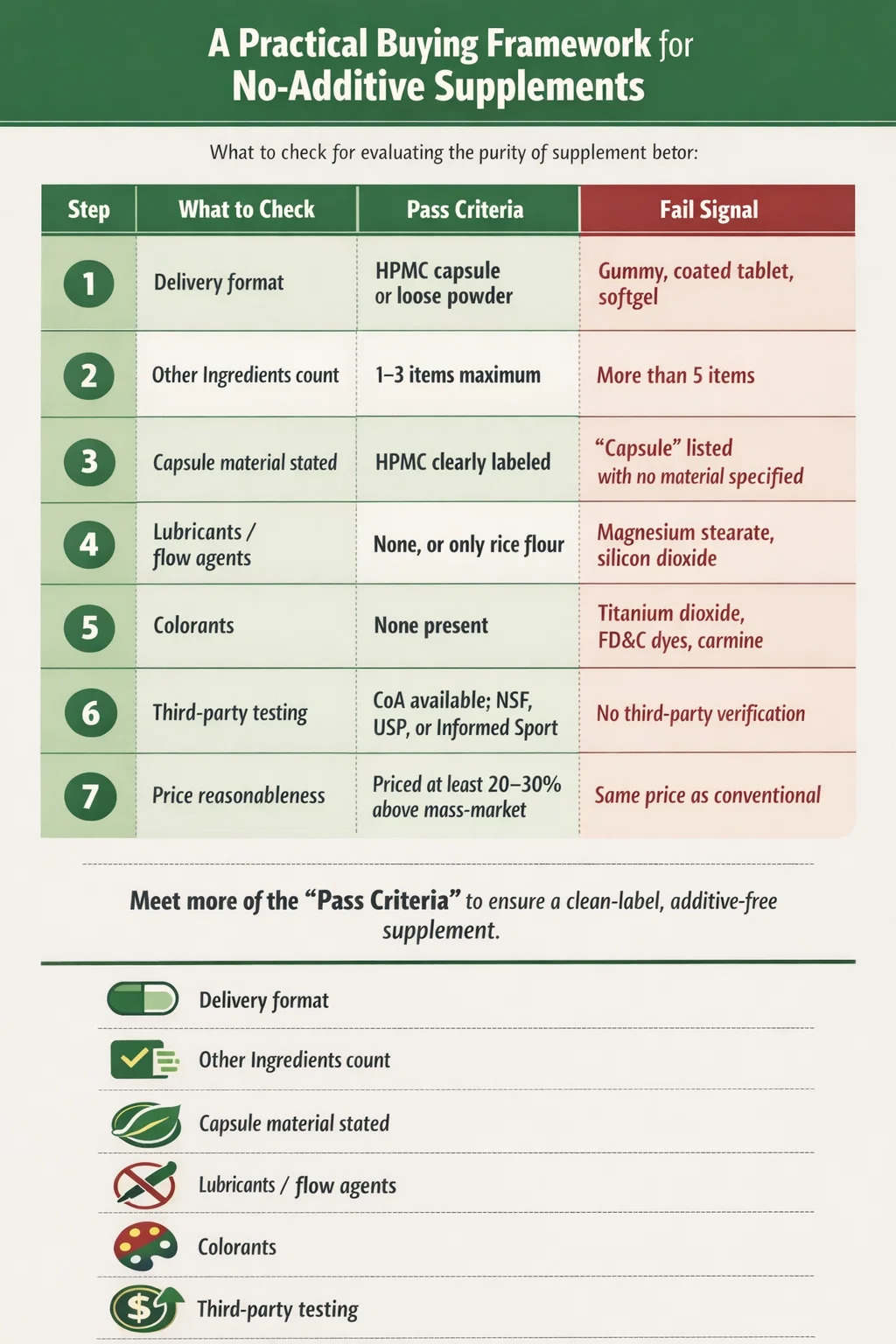
Pull this checklist out when evaluating any supplement product:
| Step | What to Check | Pass Criteria | Fail Signal |
|---|---|---|---|
| 1 | Delivery format | HPMC capsule or loose powder | Gummy, coated tablet, softgel |
| 2 | Other Ingredients count | 1–3 items maximum | More than 5 items |
| 3 | Capsule material stated | HPMC clearly labeled | "Capsule" listed with no material specified |
| 4 | Lubricants/flow agents | None, or only rice flour | Magnesium stearate, silicon dioxide |
| 5 | Colorants | None present | Titanium dioxide, FD&C dyes, carmine |
| 6 | Third-party testing | CoA available; NSF, USP, or Informed Sport cert | No third-party verification available |
| 7 | Price reasonableness | Priced at least 20–30% above mass-market equivalent | Same price as conventional — raises sourcing questions |
No product will ever be perfect against every criterion. The goal is not perfection but informed prioritization. Choosing an HPMC capsule format with fewer than four total ingredients and third-party testing puts you in the top tier of clean-label supplement selection — regardless of whatever marketing language is printed on the front of the bottle.
Your email address will not be published. Required fields are marked *
If you would like to learn more about our products, please feel free to contact us and we will do our to assist you.
Copyright © Shaoxing Zhongya Capsule Co., Ltd. High Quality Empty Capsule Manufacturers Wholesale Transparent Empty Capsule Factory
All Rights Reserved.

