
 English
 中文简体
中文简体 русский
Product Consultation
Your email address will not be published. Required fields are marked *

Content
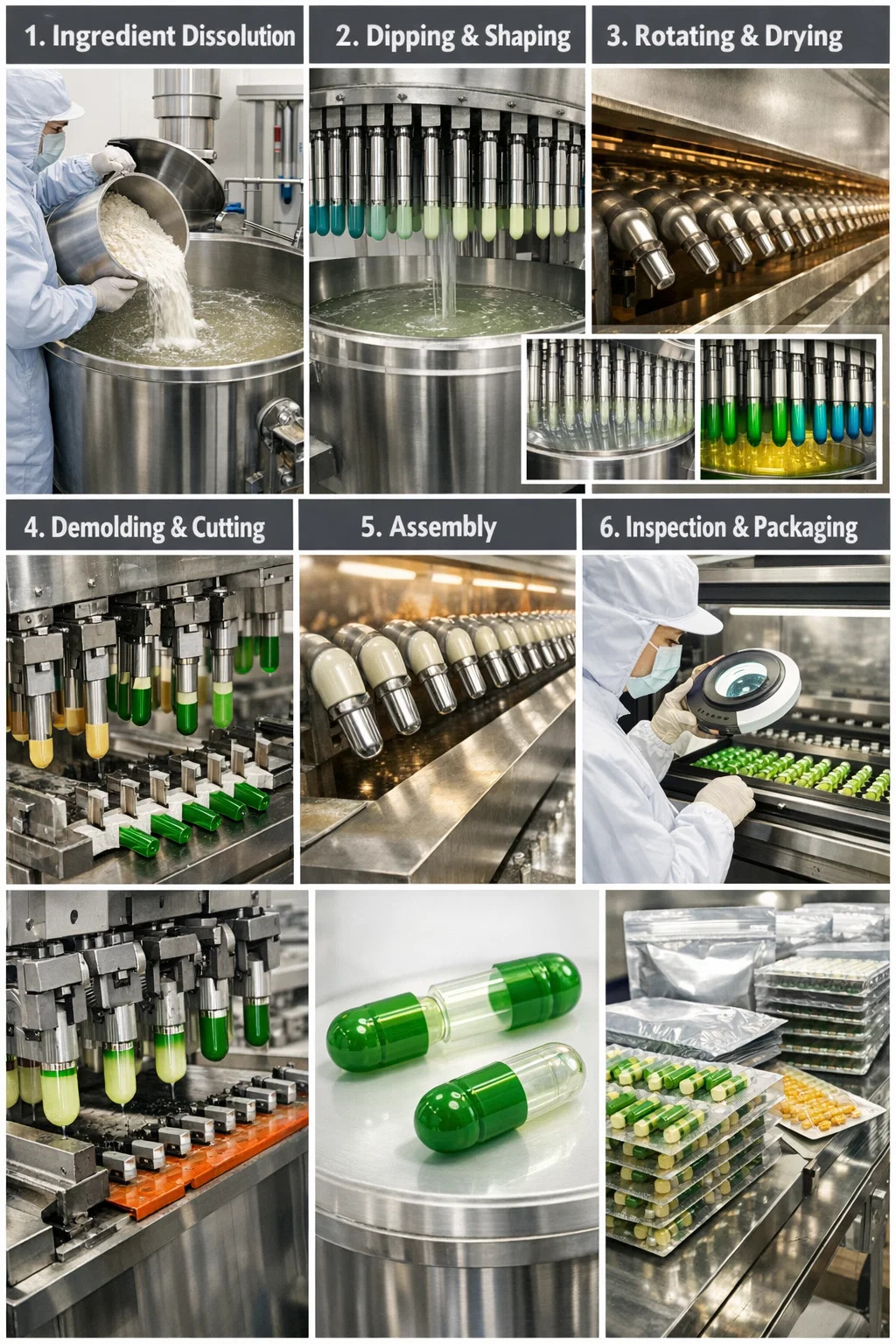
The process of manufacturing HPMC capsules isn't as mysterious as you might think. If you've ever seen how hollow chocolates or candied fruit skewers are made, the principle is quite similar, except the hygiene requirements are tens of thousands of times stricter.
This is the first step; the raw materials must be turned into a liquid.
Formulation: Workers pour HPMC powder (which looks like white flour), extracted from pine wood or cotton, into large stainless steel tanks.
Boiling: Purified water is added, and through heating and stirring, it's boiled into a viscous, honey-like transparent liquid.
Adding Color: If the customer orders colored plant-based capsules, food coloring (such as natural chlorophyll or titanium dioxide) is added at this stage to color the "glue" to the desired shade.
This is the most crucial step; the capsule shells are created here.
Molds Appear: The machine has rows of stainless steel molds that look like smooth "metal fingers" (professionally called mold pins). These "fingers" are divided into two groups: one thicker set (for the capsule body) and one thinner set (for the capsule cap).
Precise Dipping: The machine quickly dips these "fingers" into the prepared HPMC glue solution. This dipping process is very precise; the time cannot be too long or too short, ensuring that the mold is coated with a layer of glue of uniform thickness.
The "fingers" that have just been dipped in the glue are still wet and cannot be touched immediately.
Aerial Acrobatics: To prevent the glue from flowing downwards due to gravity, causing the capsule to be top-heavy and uneven in thickness, these mold rods continuously rotate and spin on a conveyor belt.
Into the Oven: While rotating, they pass through a long drying tunnel. Because HPMC capsules are more heat-resistant than traditional gelatin capsules, the temperature and airflow here are carefully controlled to evaporate the water, turning the liquid layer into a hard, resilient thin shell.
After emerging from the drying tunnel, the capsule shells have hardened and taken shape.
Demolding: The machine uses specialized claws to gently peel the thin shell off the "metal fingers."
Trimming: The edges of the newly peeled shells are uneven. A row of blades on the machine quickly cuts off the excess edges, giving the capsule shells a neat "haircut" and ensuring that each capsule is precisely the same length.
Up to this point, the capsule's "cap" and "body" have been manufactured on two separate lines.
Pre-locking: The machine pairs them together and gently fits them. Note that they are usually not completely locked at this stage (this is called the pre-locked state), leaving a small gap.
Why leave a gap: This is for the convenience of the pharmaceutical companies later on. After purchasing the capsules, the pharmaceutical companies can easily separate them, fill them with powder, and then completely seal them.
The finished plant-based capsules still have to pass one last test.
Sharp Eyes: High-precision cameras or manual light inspection are used to eliminate all defective products with bubbles, dents, or uneven cuts.
Packaging: The qualified capsules are packed into moisture-proof bags and cardboard boxes, ready to be shipped to pharmaceutical and health product manufacturers worldwide.
Your email address will not be published. Required fields are marked *
If you would like to learn more about our products, please feel free to contact us and we will do our to assist you.
Copyright © Shaoxing Zhongya Capsule Co., Ltd. High Quality Empty Capsule Manufacturers Wholesale Transparent Empty Capsule Factory
All Rights Reserved.

