
 English
 中文简体
中文简体 русский
Product Consultation
Your email address will not be published. Required fields are marked *

Content
The core difference is simple: gelatin capsules are made from animal-derived collagen, while HPMC capsules (hydroxypropyl methylcellulose capsules) are plant-based. That single distinction cascades into meaningful differences in moisture content, dissolution behavior, stability under heat and humidity, compatibility with hygroscopic fills, and suitability for vegetarian, vegan, or halal markets. If you are choosing a capsule shell for a supplement or pharmaceutical product, the decision between these two types will affect your formulation, your shelf life, your target consumer, and your cost structure.
Gelatin capsules have been the industry standard for over a century. They are produced by processing collagen extracted from the bones, skin, and connective tissue of bovine (cattle) or porcine (pig) sources. The raw collagen is hydrolyzed, purified, and formed into thin shells through a dipping process. The result is a transparent or semi-transparent shell with a smooth texture and a well-understood dissolution profile.
Hard gelatin capsules, also called two-piece capsules, consist of a body and a cap that fit together to enclose a powder, pellet, or granule fill. Soft gelatin capsules (softgels) are one-piece shells typically used for liquid or semi-solid fills such as fish oil, vitamin E, or CoQ10. The manufacturing process for softgels uses a rotary die method, while hard gelatin capsules are filled separately after production.
Standard hard gelatin capsules contain approximately 13–16% moisture at equilibrium. This moisture is integral to the mechanical integrity of the shell — too little and the capsule becomes brittle; too much and it softens and deforms. This moisture sensitivity is one of the primary limitations of gelatin shells.
HPMC capsules, also referred to as vegetarian capsules, veggie caps, or plant-based capsules, are manufactured from hydroxypropyl methylcellulose — a semi-synthetic polymer derived from cellulose, the structural component of plant cell walls. The cellulose is chemically modified through hydroxypropylation and methylation to produce a water-soluble, film-forming material suitable for capsule production.
There are two main types of HPMC capsules on the market. The first type uses a gelling agent, typically carrageenan or gellan gum, to achieve the gel-setting behavior needed during the dipping and drying process. The second type is a newer generation of HPMC capsule that uses a thermal gelation mechanism — the HPMC itself gels upon heating — eliminating the need for additional gelling agents. This second type is often marketed as "clean label" and may be preferred by formulators concerned about carrageenan.
HPMC capsules typically contain only 4–6% moisture, which is significantly lower than gelatin. This low equilibrium moisture content is one of the most practically important properties of HPMC shells, especially when working with moisture-sensitive active ingredients.
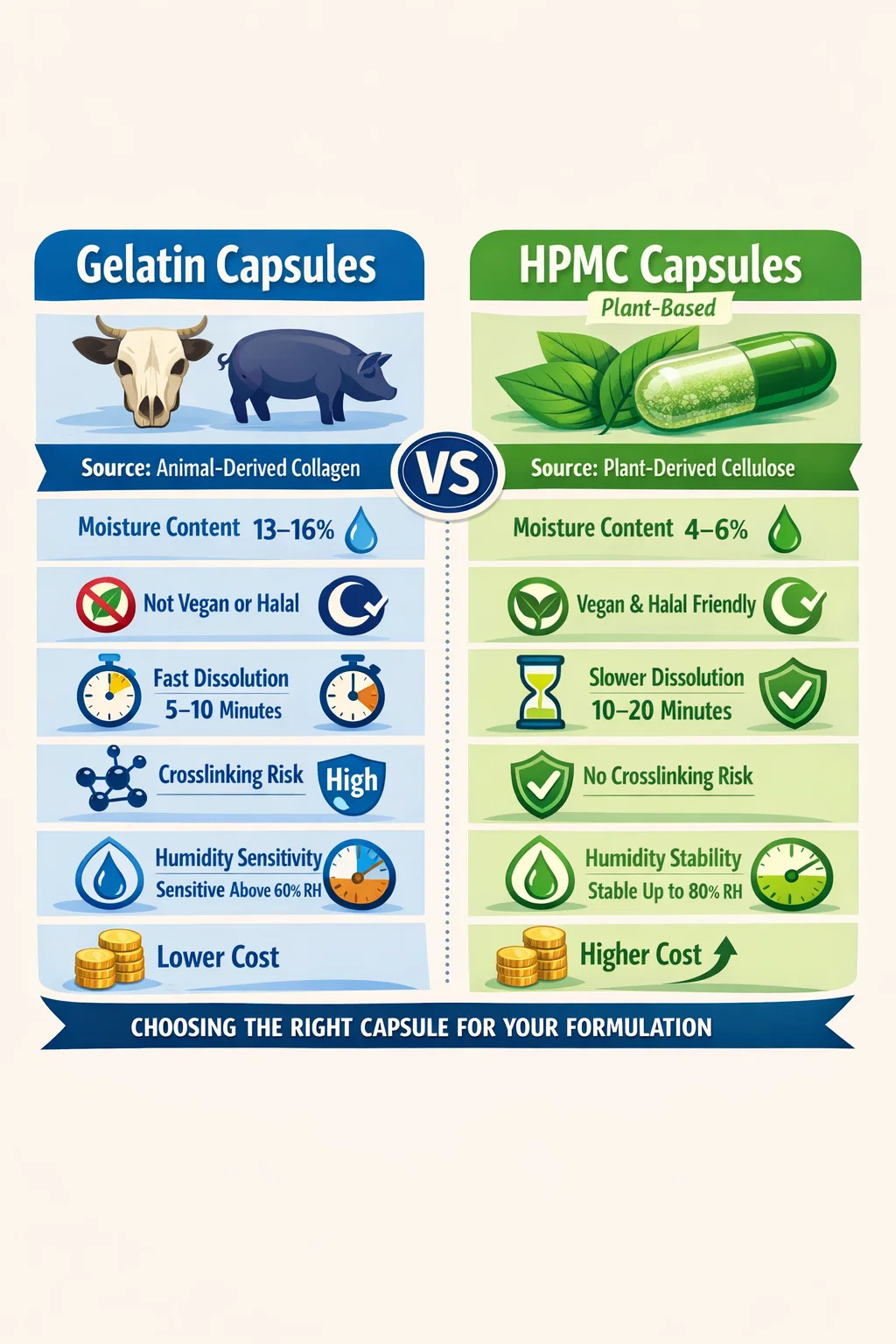
The table below summarizes the most critical technical and commercial differences between the two capsule types.
| Property | Gelatin Capsules | HPMC Capsules |
|---|---|---|
| Source Material | Bovine or porcine collagen | Plant-derived cellulose |
| Equilibrium Moisture | 13–16% | 4–6% |
| Dietary Suitability | Not vegetarian or vegan; may conflict with halal/kosher depending on source | Vegetarian, vegan, halal, kosher |
| Dissolution Rate | Fast — typically disintegrates in 5–10 minutes in gastric fluid | Slightly slower — typically 10–20 minutes; more consistent across pH ranges |
| Crosslinking Risk | High — aldehydes in fill can crosslink gelatin, slowing dissolution | Very low — not susceptible to crosslinking |
| Humidity Stability | Moderate — softens above 60–65% RH | Good — maintains integrity up to ~80% RH |
| Oxygen Permeability | Higher | Lower — better protection for oxidation-sensitive ingredients |
| Cost | Lower — well-established supply chain | Higher — typically 20–50% more expensive per unit |
| Printing and Marking | Excellent — widely compatible with inks | Good — compatible but may require ink adjustment |
| Fill Compatibility | Broad; not ideal for hygroscopic or aldehyde-containing fills | Excellent for hygroscopic, moisture-sensitive, or reactive fills |
Dissolution is a central concern in pharmaceutical and nutraceutical formulation. Both capsule types disintegrate and release their contents in aqueous environments, but the mechanism and speed differ in ways that matter clinically and commercially.
Gelatin forms a thermoreversible gel. In gastric fluid at body temperature (37°C), gelatin capsules swell, rupture, and dissolve relatively quickly. In standard disintegration testing using simulated gastric fluid (SGF) at pH 1.2, hard gelatin capsules typically disintegrate within 5 to 10 minutes. This speed is considered favorable for immediate-release formulations where rapid onset is needed.
However, gelatin is vulnerable to a process called crosslinking. When the fill material contains aldehydes — including common excipients like povidone (which can contain peroxide impurities that form aldehydes), or certain spray-dried extracts — these compounds react with the amine groups in gelatin protein chains. This crosslinking creates additional covalent bonds in the shell, making it resistant to dissolution. In extreme cases, a crosslinked gelatin capsule will pass the disintegration test visually intact, forming what regulators describe as a "pellicle" — a tough, insoluble membrane surrounding the fill. This failure mode is well-documented in FDA guidance documents and has led to product recalls.
HPMC capsules dissolve by a different mechanism. HPMC is water-soluble under cold and neutral-to-acidic conditions, but gels when heated above approximately 50–55°C. At body temperature (37°C), HPMC capsules dissolve by gradual hydration and erosion of the shell matrix. This is inherently slower than gelatin dissolution — HPMC capsule disintegration in SGF typically takes 10 to 20 minutes depending on the specific grade and gelling agent used.
Critically, HPMC is not a protein and therefore has no amine groups available for crosslinking reactions. This means aldehyde-containing fills, peroxide-generating excipients, and reactive botanical extracts pose no crosslinking risk to HPMC shells. For formulators working with challenging active pharmaceutical ingredients (APIs) or extracts, this is a substantial advantage.
HPMC capsules also show more consistent dissolution across a range of pH values. In some studies, gelatin capsule dissolution slowed significantly in simulated intestinal fluid (SIF) at pH 6.8 compared to SGF, while HPMC capsule disintegration remained relatively stable. For products intended to release their contents across multiple GI compartments, this consistency is valuable.
Moisture management is one of the most overlooked aspects of capsule selection, and it is where HPMC capsules offer a particularly clear and quantifiable advantage for certain fills.
Gelatin capsules carry a significant water reservoir — up to 16% by weight — that can migrate into a hygroscopic fill over time. For an active ingredient that hydrolyzes in the presence of water (such as aspirin, certain peptides, or many probiotics), this moisture transfer can degrade the product during storage. The degree of moisture transfer depends on the water activity gradient between the shell and the fill, the storage temperature, and the packaging conditions.
HPMC capsules, with only 4–6% equilibrium moisture, transfer substantially less water to hygroscopic fills. For probiotics in particular, which are among the most moisture-sensitive fills in the supplement industry, HPMC capsules have become the dominant choice. Probiotic viability over a 24-month shelf life can differ by an order of magnitude depending on the capsule shell type, with HPMC consistently outperforming gelatin when other packaging variables are held constant.
Gelatin capsules become soft and tacky at relative humidity levels above approximately 60–65%. In tropical climates or during warm-season shipping, this can lead to capsules sticking together inside bottles, deforming under the weight of fill material, or becoming difficult to handle on packaging lines. This is why gelatin capsule products destined for Southeast Asian, South Asian, or sub-Saharan African markets often require additional packaging engineering — desiccants, foil pouches, or nitrogen purge — to maintain product integrity.
HPMC capsules maintain their mechanical properties up to approximately 80% relative humidity, making them more robust for global distribution and warm-climate markets. This stability advantage can reduce packaging complexity and associated costs, partially offsetting the higher per-unit price of HPMC shells.
The moisture dependency of gelatin works in both directions. Below about 10% relative humidity — conditions found in winter-climate warehouses or during high-altitude air transport — gelatin capsules lose moisture, becoming brittle and prone to cracking during filling, transport, or use. HPMC capsules are considerably less sensitive to low-humidity brittleness, which reduces breakage rates on high-speed capsule filling machines operating in dry environments.
The market for plant-based supplements and pharmaceuticals has grown substantially over the past decade, and capsule shell type is a direct part of this market signal. HPMC capsules are suitable for consumers who follow vegetarian or vegan diets, and they are inherently free from animal-derived materials. This makes them appropriate for labeling as "vegetarian capsules" or "vegan capsules" — designations that appear on a growing proportion of supplement packaging.
Gelatin derived from porcine sources is prohibited under Islamic dietary law (halal) and Jewish dietary law (kosher). Bovine gelatin can be halal or kosher certified if the animal was slaughtered according to the relevant religious requirements and the processing facility meets certification standards, but certification is not automatic and must be verified with documentation. HPMC capsules require no religious certification for halal or kosher compliance, simplifying the supply chain and the labeling process for manufacturers targeting these consumer groups.
According to market research from Grand View Research, the global vegetarian capsule market — dominated by HPMC — was valued at over USD 360 million in 2022 and is projected to grow at a compound annual growth rate of approximately 8% through 2030, driven partly by increasing consumer demand for clean-label and plant-based supplement products. This growth outpaces the overall gelatin capsule market, signaling a gradual shift in industry preference.
Oxygen permeability through the capsule shell is a relevant factor for fills that are prone to oxidation — fish oil, astaxanthin, fat-soluble vitamins, CoQ10, and many botanical extracts. HPMC has lower oxygen permeability than gelatin at equivalent shell thickness and moisture content.
One study published in the International Journal of Pharmaceutics demonstrated that fills encapsulated in HPMC hard capsules showed significantly lower peroxide values (a measure of lipid oxidation) after accelerated stability testing compared to identical fills in hard gelatin capsules. While the capsule shell is not the primary oxygen barrier in most packaging systems — that role belongs to the bottle or blister — for products where the capsule itself is the last line of defense before the fill, HPMC's lower permeability provides a measurable advantage.
For liquid-fill hard capsules (LFHC), where a liquid or semi-solid fill is sealed inside a banded hard capsule, the shell's barrier properties become even more important because the fill is in direct and continuous contact with the inner surface of the shell. HPMC LFHC systems are used for sensitive lipid-based formulations where the lower moisture and oxygen permeability of HPMC provide tangible shelf-life benefits.
Not all active ingredients are equally compatible with both capsule types. Understanding fill-shell compatibility prevents stability failures, bioavailability problems, and regulatory rejections.
Cost is a real factor in capsule selection, particularly for high-volume products. Gelatin capsules benefit from a mature, large-scale global supply chain. Major manufacturers — Capsugel (now part of Lonza), Qualicaps, ACG, and Suheung — produce gelatin capsules at enormous volumes, which drives down per-unit costs. For a standard size 0 hard gelatin capsule purchased in commercial quantities, pricing typically falls in the range of USD 8–15 per thousand units, depending on volume and specification.
HPMC capsules typically cost 20–50% more per unit than comparable gelatin capsules. For a product with a 60-capsule serving size selling at USD 30–40 retail, this cost difference is usually absorbable. For a commodity supplement selling at USD 8–10 per bottle, the difference in capsule cost can represent a meaningful margin impact. However, the cost calculation should also factor in potential savings from reduced packaging complexity (fewer desiccants, simpler foil requirements), fewer stability-related reformulations, and market access to premium vegetarian and vegan consumer segments willing to pay a higher retail price.
From a regulatory cost perspective, HPMC capsules are well-established in both USP and Ph.Eur. monographs and are included in the FDA's Inactive Ingredient Database for oral dosage forms. Switching from gelatin to HPMC in a pharmaceutical product may require a supplemental filing or change notification, but this is generally not a major barrier for well-characterized products.
Both gelatin and HPMC capsules are compatible with standard high-speed capsule filling machines, including intermittent-motion and continuous-motion dosators and tamping pin fillers. However, there are practical differences in handling that formulators and contract manufacturers should account for.
HPMC capsules tend to have slightly lower mechanical elongation at break compared to gelatin under dry conditions, which means filling machines operating at low relative humidity may see marginally higher cap or body breakage rates. Most modern filling machines can be adjusted for HPMC capsule dimensions and brittleness profiles, but a production trial is advisable when switching from gelatin to HPMC on an existing line.
HPMC capsules also have slightly different coefficient of friction values compared to gelatin, which can affect capsule orientation and transport on vibrating sorting trays. Again, this is a manageable variable that most experienced capsule filling operations have encountered and addressed.
For liquid-fill applications with hard capsules, HPMC shells require banding (a thin strip of HPMC solution applied around the cap-body join) to seal the capsule against liquid leakage. Gelatin capsules can also be banded, but the process is essentially the same. Specialized equipment such as the Capsugel LiquigelTM system has been designed specifically to work with HPMC for liquid-fill applications.
Based on the technical properties described above, the following scenarios represent clear indications for choosing HPMC capsules:
Conversely, gelatin capsules remain a rational choice when the fill is non-reactive and non-hygroscopic, the target consumer has no dietary restrictions that preclude animal-derived ingredients, rapid dissolution in gastric fluid is the primary design goal, cost minimization is critical, or the product is a softgel (where HPMC-based softgel technology is still less mature and less widely available than gelatin softgels).
While the choice in most formulations comes down to gelatin versus HPMC, it is worth noting that other capsule shell materials exist. Pullulan capsules, made from a polysaccharide produced by the fungus Aureobasidium pullulans, are also plant-based and offer exceptionally low oxygen permeability — approximately 300 times lower than HPMC according to data from Capsugel's Plantcaps product line. Pullulan capsules are used for premium oxidation-sensitive formulations but come at a significantly higher cost than either gelatin or HPMC.
Starch-based capsules are another option used in some markets, and fish gelatin capsules offer a halal-compatible alternative to porcine or bovine gelatin for consumers who avoid land animals but do not follow a strict vegetarian diet. Each of these represents a niche solution for specific formulation or market requirements, but HPMC capsules remain the dominant non-gelatin option across both supplement and pharmaceutical applications globally.
Your email address will not be published. Required fields are marked *
If you would like to learn more about our products, please feel free to contact us and we will do our to assist you.
Copyright © Shaoxing Zhongya Capsule Co., Ltd. High Quality Empty Capsule Manufacturers Wholesale Transparent Empty Capsule Factory
All Rights Reserved.

